Puppy Crying When Left Alone? 6 Fixes
Puppy crying when left alone? Why it happens, the six-step training plan that builds alone-time, and how to tell normal protest from separation anxiety.
On this page
- Why puppies cry when alone
- Fix 1: Rule out the physical needs first
- Fix 2: Train in seconds, not hours
- Fix 3: Make the departure boring
- Fix 4: Give them something better to do
- Fix 5: Use the crate properly, or use a pen
- Fix 6: Know the difference between protest and anxiety
- The night version of the same problem
- How long it takes
- The bottom line
A puppy crying when left alone is not being naughty, spoiled, or manipulative. Puppies come from a litter where they have never once been by themselves, and being alone is a skill they have to be taught rather than something they arrive knowing.
The good news is that it responds well to training. The bad news is that the instinctive response — going back in to comfort them — is what usually makes it last longer.
The short version
Build alone-time in seconds, not hours. Leave while the puppy is calm, return before they start crying, and increase the gap gradually. Meet physical needs first: a puppy that needs the toilet or a nap will cry no matter how good your training is.
Why puppies cry when alone
Three separate things are usually going on, and they need different responses.
It is biologically normal. A puppy alone in the wild is a puppy in danger. Vocalizing to summon the group is hardwired, not learned. An eight-week-old puppy has been surrounded by littermates every minute of its life until the week it came home.
It might be a genuine need. Young puppies cannot hold their bladder long, get hungry quickly, and get overtired fast. Crying may simply be a request.
It may have been accidentally trained. If crying reliably produces a person, the puppy has learned an effective way to get one.
Telling these apart is the whole job. The first fades with age and training, the second needs meeting, and the third needs a change in your response.
Fix 1: Rule out the physical needs first
Before any training, run the checklist. A puppy will cry through the best plan in the world if one of these is unmet.
- Toilet: a puppy can hold roughly its age in months plus one, in hours. An eight-week-old maxes out around three hours.
- Sleep: young puppies need 18–20 hours a day and fight sleep when overtired.
- Food and water: a small meal 60–90 minutes before you leave.
- Exercise: short and age-appropriate, not a long walk.
- Temperature: too hot or too cold both cause restlessness.
The sleep one catches most people out. An overtired puppy gets more frantic, not less, and a lot of “separation crying” is a puppy who badly needs a nap — the puppy sleep schedule by age covers how much they actually need.
Fix 2: Train in seconds, not hours
This is the core technique, and the part people rush.
Start with your puppy settled in a pen or crate with something to chew. Then:
- Walk two steps away. Come back before they react. Reward the calm.
- Walk out of the room for three seconds. Return. Repeat until boring.
- Build to 30 seconds, then a minute, then five.
- Vary the duration. Ten seconds, then two minutes, then five, then thirty seconds. Never a steady climb, or the puppy learns each absence is longer.
- Only ever return when they are quiet. Even a two-second pause counts.
The rule that makes it work: return before the crying starts, not after. Every repetition where the puppy stays calm and you come back teaches “they always come back.” Every repetition where you return to crying teaches “crying brings them back.”
Expect this to take two to four weeks of short daily sessions. It is boring. It is also the thing that works.
Fix 3: Make the departure boring
Dogs read the pre-leaving routine long before you reach the door — keys, shoes, coat, bag. For an anxious puppy the anxiety starts building at the first cue.
Break the pattern: pick up your keys and sit down. Put your shoes on and make a cup of tea. Do this dozens of times until the cues stop predicting anything.
Keep goodbyes and hellos flat. No emotional farewell, no ecstatic greeting. An excited return makes your absence the worst part of the day by contrast. Ignore the puppy for the first minute back, then greet calmly once they settle.
Fix 4: Give them something better to do
A puppy left with nothing has only one job: notice you are gone.
- A stuffed rubber toy, frozen for longer sessions
- A lick mat with something soft spread on it
- A safe chew appropriate for their age
- A snuffle mat with part of their meal scattered in it
Give it as you leave, not before. The chew becomes something that predicts your departure rather than a treat they finish while you are still there.
Licking and chewing are genuinely calming for dogs — it is not a distraction so much as a physiological off-switch. If chewing is a problem generally, chew toys for teething puppies covers what actually survives a puppy.
Fix 5: Use the crate properly, or use a pen
A crate helps enormously if the puppy already loves it, and makes everything worse if it does not. A puppy shut in an unfamiliar crate and left will panic, and now you have two problems.
Build the association first — meals in the crate, door open, naps with the door open, then short closed periods while you are present. The crate training guide walks through the gentle version.
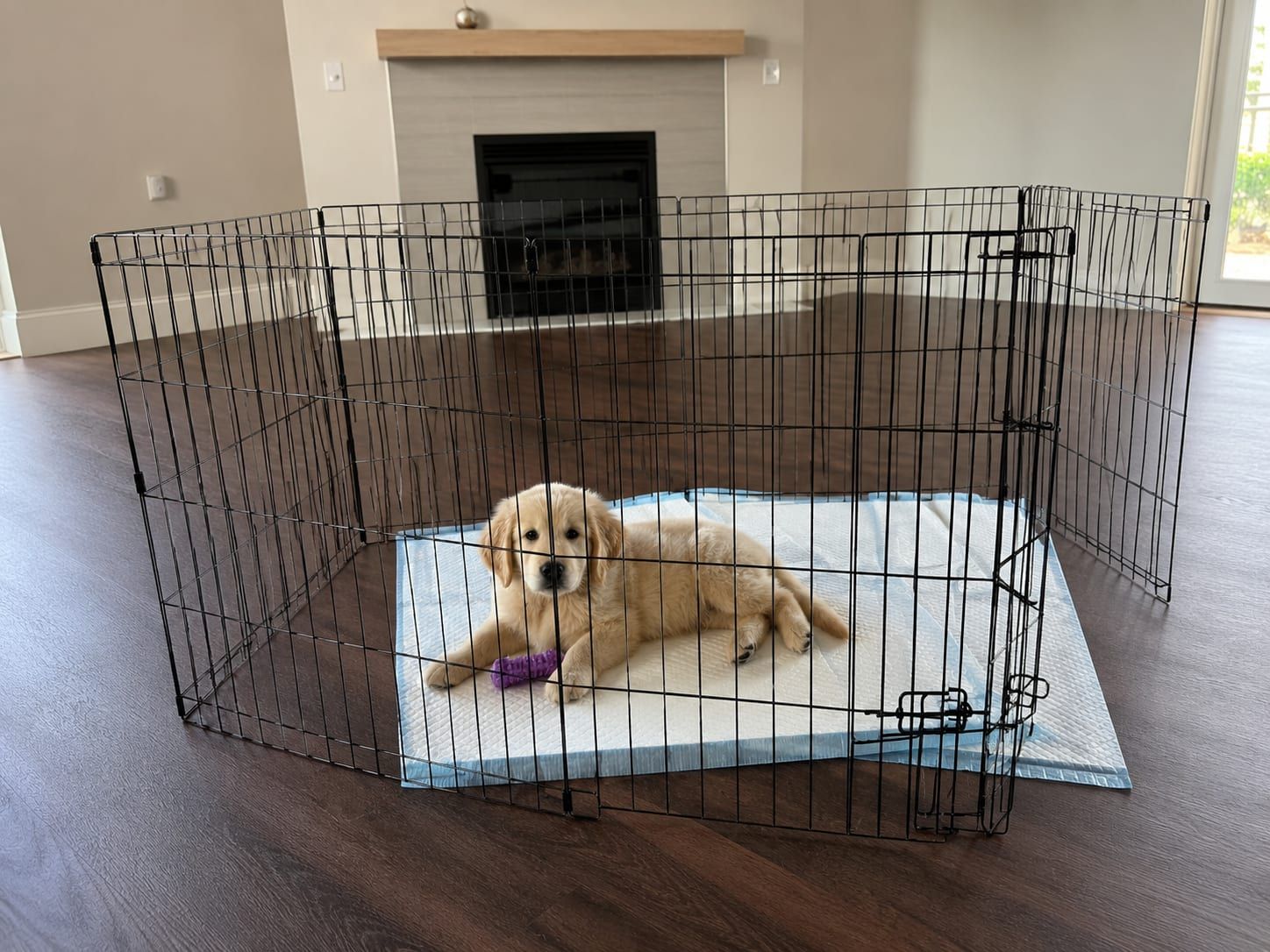
If your puppy already has a bad crate association, use a puppy pen instead. A pen with a bed, water, a chew and a toilet area is a perfectly good alternative and avoids weeks of undoing a fear.
Camera first, conclusions second
Point a phone or a cheap pet camera at the puppy before you assume anything. Most owners discover the puppy cries for four minutes and then sleeps — which is normal protest, not distress. Others discover continuous panic, drooling or destruction at the door, which is a different problem entirely. You cannot tell from the other side of the door.
Fix 6: Know the difference between protest and anxiety
This distinction changes what you should do.
Normal protest crying starts as you leave, lasts a few minutes, and stops. The puppy then settles or sleeps. It fades over weeks as training builds. Keep going with the plan.
Separation anxiety looks different:
- Crying, howling or barking that continues the whole time you are gone
- Drooling, panting, trembling
- Destruction focused on doors and windows — the exit points
- Toileting indoors despite being reliably house-trained
- Refusing food or a favorite chew the entire time
- Distress that begins before you even leave
If several of those apply, stop extending absences. Every panicked absence makes it worse, so the training has to happen below the threshold where panic starts — which may mean starting at two seconds again.
When to get help
Talk to your vet if your puppy shows sustained panic, injures itself trying to escape, or has not improved after four weeks of consistent gradual training. Sudden separation distress in a dog that was previously fine can also have a medical cause and is worth a check. Genuine separation anxiety usually needs a qualified force-free trainer or a veterinary behaviorist, and it responds much better to early intervention than to waiting it out.
The night version of the same problem
Night crying and daytime alone-crying have the same root but a different fix.
For the first week or two, put the crate beside your bed. The puppy is not alone, so there is nothing to panic about, and you will hear a genuine toilet stir before it becomes a full meltdown. Then move the crate gradually — a few feet a night — toward where you want it to live.
Young puppies genuinely cannot last the night, so a scheduled toilet trip is not giving in. Keep it dull: outside, quiet praise, straight back to bed, no play and no lights. The potty training guide covers the night routine in more detail.
How long it takes
Most puppies handle 1–2 hours alone by around 12–16 weeks, given consistent short sessions. Working up to a normal four-hour absence usually takes two to three months of gradual building.
Adult dogs should not routinely be left more than about four to six hours, and puppies far less. If your working day is longer than that, plan for a midday visit, a walker, or daycare — no amount of training changes how long a young bladder lasts.
The bottom line
Meet the physical needs, then build alone-time in seconds while returning before the crying starts. Make leaving boring and give them something worth chewing as you go.
Point a camera at them before you decide how bad it is — most puppies cry for a few minutes and then sleep. If yours panics for the whole absence, stop extending and get help early.
Frequently asked questions
Should I ignore my puppy crying when left alone?+
Not exactly. Ignoring works for attention-seeking protest in a puppy whose physical needs are met, but a young puppy may genuinely need the toilet, and ignoring real distress makes separation anxiety worse. Point a camera at them: if the crying stops within a few minutes and they settle, that is normal protest. If it continues the whole time with panting, drooling or destruction, that is anxiety and needs a different approach.
How long can a puppy be left alone?+
Very little at first. A rough guide for bladder capacity is the puppy's age in months plus one, in hours, so an eight-week-old maxes out around three hours. Most puppies manage one to two hours by 12 to 16 weeks with consistent training. Adult dogs should not routinely be left more than about four to six hours.
Why does my puppy cry the moment I leave the room?+
Because being alone is genuinely new. Puppies come from a litter where they were never by themselves, and vocalizing to summon the group is hardwired rather than learned. It is a skill they have to be taught: start with two-second absences and build up gradually, always returning while the puppy is still calm.
How do I train my puppy to be alone?+
Build in seconds rather than hours. Settle the puppy with a chew, step away briefly, and return before they react. Repeat until it is boring, then extend to 30 seconds, a minute, five minutes. Vary the durations rather than steadily increasing them, and only ever return when the puppy is quiet, even if that is just a two-second pause. Expect two to four weeks of short daily sessions.
Is it separation anxiety or just normal crying?+
Normal protest starts as you leave, lasts a few minutes, then stops, and the puppy settles or sleeps. Separation anxiety involves crying that continues the whole absence, plus drooling, panting, trembling, destruction focused on doors and windows, indoor toileting in a house-trained puppy, refusing food, and distress that begins before you even leave. A camera is the only reliable way to tell.
Should I put my puppy in a crate when I leave?+
Only if the puppy already loves the crate. A puppy shut in an unfamiliar crate and left alone will panic, which creates a second problem on top of the first. Build the association first with meals and open-door naps. If your puppy already dislikes the crate, use a puppy pen with a bed, water, a chew and a toilet area instead.
Does leaving the TV or radio on help?+
It can help mask sudden outside noises that startle a puppy, and some dogs settle better with background sound. But it does not address the underlying issue — a puppy that has not been taught to be alone will still cry with the radio on. Treat it as a small extra, not a substitute for gradual training.
My puppy was fine and has suddenly started crying when left. Why?+
Sudden onset in a puppy that previously coped is worth investigating rather than training through. Common triggers are a change in routine, a house move, a frightening event while alone, or an adolescent fear period around six to fourteen months. It can also have a medical cause, so a vet check is sensible before assuming it is behavioral.
Sources & further reading
This article draws on guidance from these trusted organizations. Always consult your own veterinarian for advice specific to your pet.
Written by
Raghav DeedwaniyaFounder & Editor
Raghav Deedwaniya is the founder and editor of Petifys, and the author behind its pet care content. I’m a lifelong pet owner, not a veterinarian — I’ve been around dogs since childhood, and that hands-on experience is what got me into writing about responsible pet ownership. At Petifys I create practical, easy-to-understand guides, each one carefully researched using trusted sources such as the AVMA, ASPCA and International Cat Care. My aim is to help you make informed everyday decisions — but for anything involving your pet’s health, always consult a qualified veterinarian who can examine your animal in person.
Disclosure: Some links in this article are affiliate links. If you buy through them we may earn a small commission at no extra cost to you. We only recommend products we believe in. Learn more.