How to Introduce a New Cat to Your Cat
How to introduce a new cat to your resident cat in five steps — the scent swap, the door feeding, how long it takes, and the mistake that restarts it.
On this page
- Why cats need this and dogs do not
- Before the new cat arrives
- Step 1: Total separation (3–7 days)
- Step 2: Scent swapping (3–7 days)
- Step 3: Feeding on either side of the door (5–10 days)
- Step 4: Visual contact, controlled (1–2 weeks)
- Step 5: Supervised time in the same room (1–3 weeks)
- How long the whole thing takes
- Signs it is going well
- Problems that show up afterward
- The bottom line
Knowing how to introduce a new cat to your resident cat is mostly a matter of going slower than feels reasonable. Cats are territorial in a way dogs are not, and the single most common cause of a failed introduction is putting them in the same room on day one to “let them sort it out.”
They do not sort it out. Here is the five-step process that works, and roughly how long each stage takes.
The short version
Keep the new cat in a separate room with everything they need. Swap scents before they ever see each other. Feed on opposite sides of a closed door, then a cracked door, then supervised time together. Expect two to six weeks. Go back a step at the first sign of tension.
Why cats need this and dogs do not
Dogs are social animals that meet new dogs constantly. Cats evolved as solitary hunters defending a territory, and a new cat is not a potential friend — it is an intruder in a space that is already claimed.
That is why the process is built around scent first, sight second, contact last. Cats identify each other primarily by smell. If the new cat already smells like part of the household before it is ever seen, the introduction starts from a much better place.
Rushing produces fights, and a bad first meeting is genuinely hard to undo. Two cats that have fought may take months to re-accept each other, versus the two to six weeks a proper introduction takes.
Before the new cat arrives
Set up a base camp room — a spare bedroom, office, or bathroom will do. It needs:
- Litter box, food and water, placed apart from each other
- A bed and at least one hiding place (a cardboard box is fine)
- A scratching post
- Toys
- A door that closes properly
Add a second litter box elsewhere in the house before the new cat arrives, so your resident cat is not suddenly sharing. The general rule is one box per cat plus one.
Do not skip the base camp room even if your home is small. It is the foundation of everything below.
Step 1: Total separation (3–7 days)
The new cat stays in the base camp room with the door shut. No visual contact at all.
This does two things at once: it lets the new cat decompress after a move, which is genuinely stressful, and it lets both cats become aware of each other by smell and sound without any pressure.
Spend time in the room with the new cat. Sit and read, let them approach you rather than reaching for them. Some cats settle in a day; a shy or shelter cat may take a week or more.
Move on when: the new cat is eating normally, using the litter box, and comes out to greet you rather than hiding.
Step 2: Scent swapping (3–7 days)
Now start deliberately mixing their smells.
- Swap bedding between the two cats
- Rub a soft cloth on one cat’s cheeks, then leave it where the other cat can investigate
- Swap rooms for an hour — put the resident cat in the base camp room and let the new cat explore the house, then swap back
That room swap is the most useful part, and the most often skipped. It lets the new cat learn the layout of the house without a confrontation, and lets the resident cat investigate thoroughly.
Watch for: sniffing and walking away is fine. Hissing at the cloth, growling, or spraying means slow down and repeat for a few more days.
Step 3: Feeding on either side of the door (5–10 days)
This is where the association turns positive.
Put a bowl on each side of the closed door, far enough apart that both cats will actually eat. Over several days, move the bowls a little closer.
The goal is that each cat begins to associate the other’s smell with something genuinely good. Food is the most reliable tool you have here — which is why it helps to feed measured meals rather than leaving a bowl down all day. Our guide to how much to feed a cat covers the daily amount if you are moving away from free-feeding.
Move on when: both cats eat calmly right next to the door with no growling.
Step 4: Visual contact, controlled (1–2 weeks)
Now they see each other, but cannot reach each other.
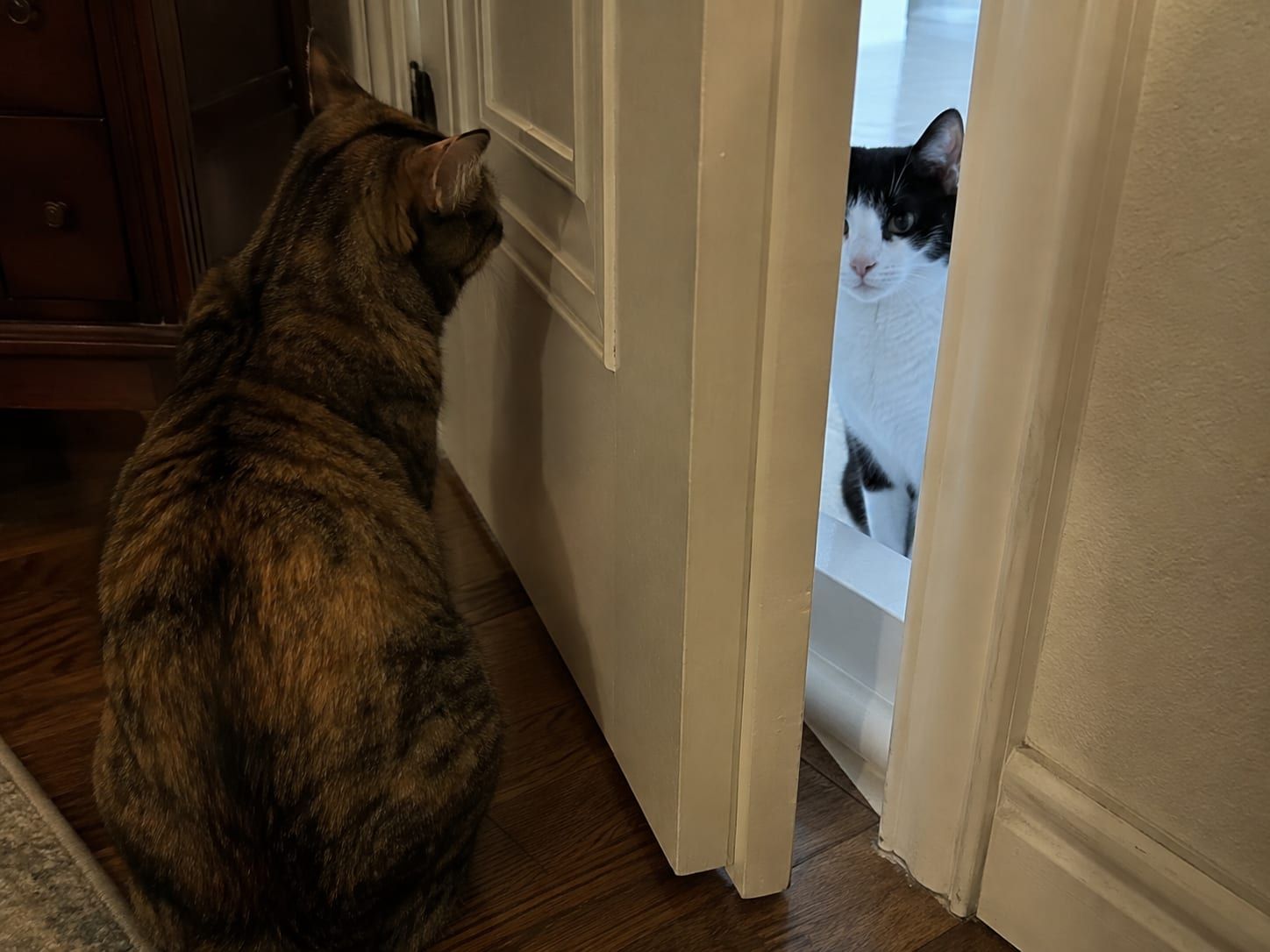
Use a door cracked a couple of inches and wedged, a baby gate, or a screen door. Keep the first sessions to 10–15 minutes, several times a day, and always end them while things are still calm rather than waiting for trouble.
Feed or play during these sessions so the other cat’s presence predicts good things. A wand toy on each side of the barrier works well.
Expect: staring, some hissing, one cat leaving. All normal. What you do not want is sustained fixation, flattened ears, growling, or a swat at the gap.
Step 5: Supervised time in the same room (1–3 weeks)
Open the barrier for short, supervised sessions in a large room with escape routes.
Rules that matter:
- Never force it. No holding a cat up to the other, no carrying one over.
- Keep sessions short and end them on a good note.
- Provide vertical space — cat trees, shelves, the top of a bookcase. Cats resolve tension by getting above each other rather than fighting.
- Have escape routes. Never let one cat get cornered.
- Distract, do not punish. If tension rises, toss a toy or make a noise to break the stare, then separate calmly.
Only leave them alone together once you have had multiple relaxed sessions with no incidents — usually a few weeks in.
When to slow down or get help
Go back a step if you see sustained growling, flattened ears, a puffed tail, or either cat stops eating or using the litter box. Those are stress signals, not stubbornness. If a cat stops eating for more than 24 hours, contact a vet — cats can develop a serious liver problem surprisingly quickly. Persistent aggression after several weeks of careful work is worth discussing with your vet or a qualified feline behaviorist rather than pushing through.
How long the whole thing takes
Most introductions take two to six weeks start to finish. The honest range is wider than that: two young, confident cats sometimes settle in ten days, while a territorial older resident cat and a nervous newcomer can take three months.
The variables that matter most:
- Age. Kittens are accepted far more readily than adult cats.
- The resident cat’s history. A cat that has always lived alone finds this much harder than one that has had feline company before.
- Sex and neutering. Neutered cats of either sex generally introduce more easily than intact ones.
- Space. More rooms, more vertical space and more escape routes all help.
Signs it is going well
- Sleeping in the same room, even at a distance
- Eating at the same time without watching each other
- Grooming themselves in each other’s presence, which signals they feel safe
- Play chasing where the roles swap and neither cat is cornered
- Eventually: mutual grooming or sleeping in contact, which is full acceptance
Problems that show up afterward
Two things commonly appear once the cats are technically living together.
Litter box trouble. Adding a cat is one of the most frequent triggers for a previously reliable cat to stop using the box. The fix is usually more boxes, placed further apart, and never in a spot where one cat can be ambushed on the way. The guide to a cat not using the litter box covers the other causes, and litter choice matters more once you have two cats producing twice the odor.
Night activity. Two cats often wind each other up after dark, especially in the first weeks. That usually settles, but if it does not, the routine fixes in why cats meow at night apply to a pair as much as to a single cat.
If this is your first cat household, the first-time cat owner’s guide covers the base setup the whole process depends on.
The bottom line
Separate room, swap scents, feed through the door, then look, then meet. Two to six weeks, and go back a step the moment either cat is tense.
The temptation is always to speed it up because the cats seem fine. The cost of rushing is a fight, and a fight sets you back further than the whole slow process would have taken.
Frequently asked questions
How long does it take to introduce a new cat?+
Most introductions take two to six weeks from arrival to unsupervised time together. Two young, confident cats sometimes settle within ten days, while a territorial older resident and a nervous newcomer can take three months. Age, whether the resident cat has lived with other cats before, neutering status and the amount of space all affect the timeline.
Can I just let the cats meet and sort it out themselves?+
No — this is the most common cause of a failed introduction. Cats evolved as solitary territorial hunters, so an unfamiliar cat is treated as an intruder rather than a potential friend. A bad first meeting can take months to undo, compared with the two to six weeks a gradual introduction takes.
What is scent swapping and why does it matter?+
Cats identify each other primarily by smell, so scent swapping lets them become familiar before they ever meet. Swap bedding between them, rub a cloth on one cat's cheeks and leave it for the other to investigate, and swap rooms for an hour so each explores the other's space. The room swap is the most useful step and the one most often skipped.
Is hissing normal when introducing cats?+
Some hissing is normal and expected, especially during early visual contact. What matters is whether it settles. Occasional hissing followed by one cat walking away is fine. Sustained growling, flattened ears, a puffed tail, fixated staring, or swatting through a barrier means you have moved too fast — go back a step and spend longer there.
How many litter boxes do I need for two cats?+
The standard guidance is one box per cat plus one, so three for two cats. Place them apart from each other rather than side by side, and never where one cat could be ambushed on the way. Adding a second cat is one of the most common triggers for a previously reliable cat to stop using the box, and box placement is usually the cause.
Should I get a kitten or an adult cat as a second cat?+
Kittens are generally accepted more readily by resident adult cats, because they are not seen as a territorial threat. But a very active kitten can be exhausting for an older or calmer cat, so matching energy levels matters too. Two cats of similar age and temperament often live together most comfortably long-term.
What if my cats fight during the introduction?+
Separate them calmly using a noise or a tossed toy to break the stare — never reach between fighting cats, as you will be injured. Then go back several steps to closed-door feeding and rebuild slowly. If serious aggression continues after several weeks of careful work, speak to your vet or a qualified feline behaviorist rather than pushing on.
How do I know when the cats have accepted each other?+
Early signs are sleeping in the same room at a distance, eating at the same time without watching each other, and grooming themselves in each other's presence — cats only self-groom when they feel safe. Full acceptance looks like mutual grooming, sleeping in contact, or relaxed play chasing where the roles swap and neither cat gets cornered.
Sources & further reading
This article draws on guidance from these trusted organizations. Always consult your own veterinarian for advice specific to your pet.
Written by
Raghav DeedwaniyaFounder & Editor
Raghav Deedwaniya is the founder and editor of Petifys, and the author behind its pet care content. I’m a lifelong pet owner, not a veterinarian — I’ve been around dogs since childhood, and that hands-on experience is what got me into writing about responsible pet ownership. At Petifys I create practical, easy-to-understand guides, each one carefully researched using trusted sources such as the AVMA, ASPCA and International Cat Care. My aim is to help you make informed everyday decisions — but for anything involving your pet’s health, always consult a qualified veterinarian who can examine your animal in person.
Disclosure: Some links in this article are affiliate links. If you buy through them we may earn a small commission at no extra cost to you. We only recommend products we believe in. Learn more.