Can Rabbits and Guinea Pigs Live Together?
Can rabbits and guinea pigs live together? The short answer is no — here is why, the four real risks, and what to do if yours already share a cage.
On this page
Can rabbits and guinea pigs live together? It is one of the most common questions in small pet keeping, partly because pet shops used to sell them as a pair, and partly because they look like they should get along.
The short answer is no. Welfare organizations including the RSPCA and PDSA advise against housing them together, and the reasons are more concrete than “they might not get on.”
The short version
Do not house rabbits and guinea pigs in the same enclosure. Four separate problems stack up: injury risk from a rabbit’s back legs, a bacterium rabbits carry that can be fatal to guinea pigs, incompatible diets, and communication that neither species understands. Each animal needs a companion of its own kind instead.
Why the pairing became common
For decades, pet shops housed and sold rabbits and guinea pigs together. They are both small, both herbivores, both quiet, and both live in hutches — so the assumption was that they were interchangeable.
Small pet welfare guidance has changed a great deal since then. The pairing persists mostly because it is what people saw growing up, not because anyone recommends it now.
The four real risks
1. Physical injury
This is the most immediate danger. A rabbit’s hind legs are extremely powerful — built for a single explosive kick. A guinea pig has a comparatively fragile spine and no equivalent defense.
A rabbit does not need to be aggressive for this to go wrong. A startled rabbit kicking out, or simply landing on a guinea pig while binkying around the enclosure, can break the guinea pig’s back. Even a rabbit that has lived peacefully with a guinea pig for a year can cause a fatal injury in one startled second.
Size makes it worse. A medium rabbit weighs three to four times what a guinea pig does.
2. Bordetella
Rabbits frequently carry Bordetella bronchiseptica in their respiratory tract without showing any symptoms at all. In guinea pigs, the same bacterium is a serious cause of pneumonia and can be fatal.
This is the risk owners most often have not heard of, and it is the one that does not care how well the animals get on. A completely healthy-looking rabbit can be shedding an organism that kills its cage mate.
3. Different diets
The diets look similar but differ in a way that matters enormously.
Guinea pigs cannot make their own vitamin C and need a daily dietary source or they develop scurvy. Rabbits produce their own, so rabbit pellets contain no added vitamin C.
Share a bowl and one of two things happens: the guinea pig eats rabbit pellets and slowly becomes vitamin C deficient, or the rabbit eats the guinea pig’s higher-calorie food and gains weight. Usually both.
The details are in what rabbits eat and what guinea pigs can eat — worth comparing side by side, because the overlap is smaller than it looks.
4. They do not speak the same language
Rabbits and guinea pigs communicate completely differently, and neither can read the other.
A rabbit signals with body position, ear angle, thumping and mounting. A guinea pig signals mostly with sound — wheeking, rumbling, teeth chattering. When a guinea pig chatters its teeth as a warning, the rabbit has no idea what that means and does not back off. When a rabbit mounts to assert dominance, the guinea pig cannot escape or respond appropriately.
The result is a guinea pig living in constant low-level stress, often bullied away from food and hiding places. Learning what guinea pig sounds mean makes this obvious: a pig housed with a rabbit frequently goes quiet, which is exactly the signal that something is wrong.
“But mine have lived together for years”
This comes up a lot, and it deserves a straight answer rather than a lecture.
Some pairs do coexist without an obvious incident, particularly if raised together from very young. Welfare organizations acknowledge this while still advising against the arrangement, because the absence of a visible problem is not the same as the absence of harm.
Two things are usually happening in a long-standing pair:
- The stress is chronic rather than dramatic. Guinea pigs hide distress well. A pig that is eating less, hiding more and vocalizing less is showing you something, but it looks like a quiet pet rather than a problem.
- The injury risk has not yet been realized. It is a probability, not a certainty, and it stays live for the entire time they share space.
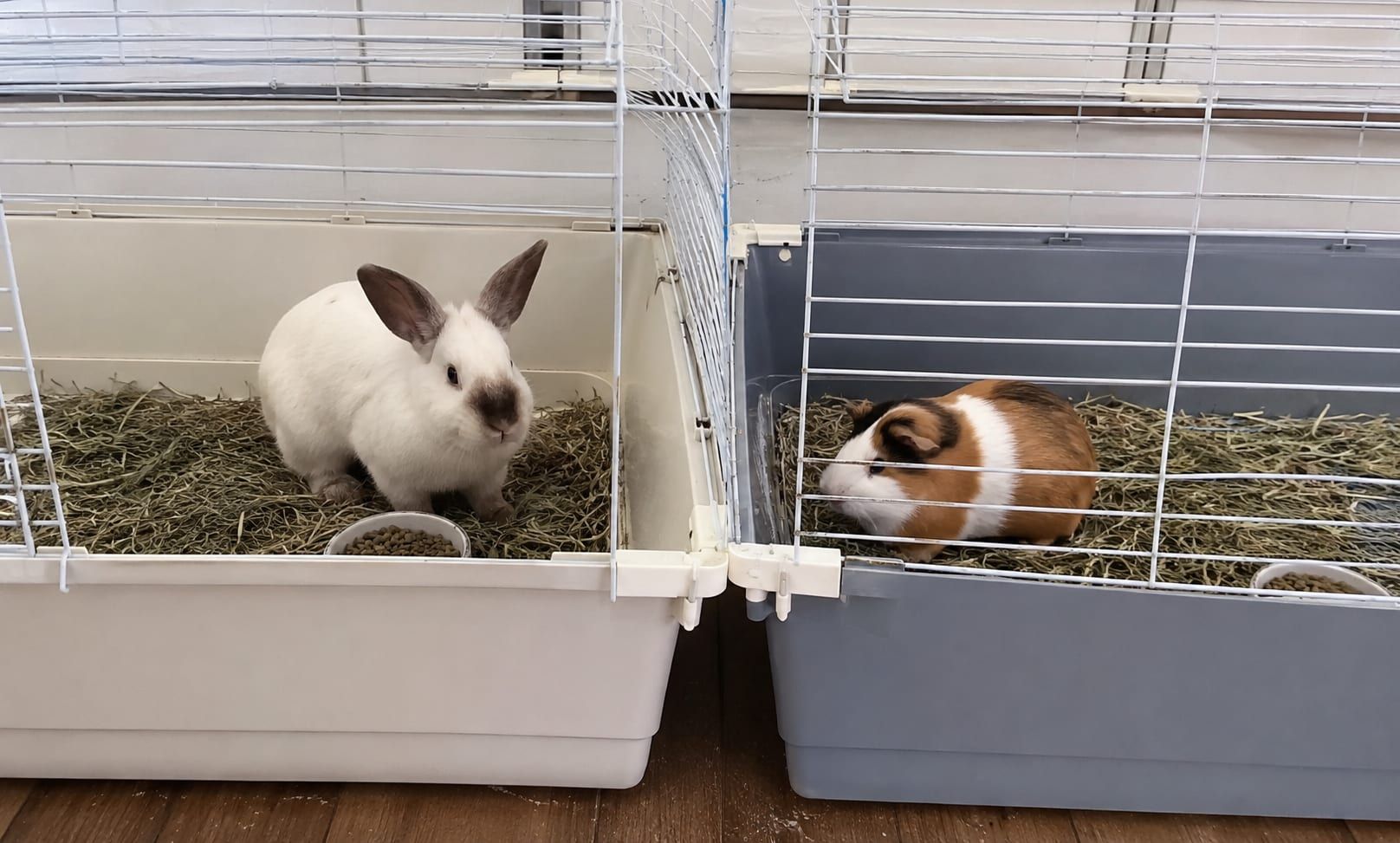
If yours already live together and seem genuinely settled, separating them abruptly can itself be stressful. The sensible approach is a gradual one: house them in adjacent enclosures where they can still see and smell each other, then work on getting each a companion of its own species. Ask your vet if you are unsure how to manage the transition.
What each animal actually needs instead
Both species are social. Neither should live alone — that is the real reason people pair them up in the first place, and the need is genuine. The fix is a same-species companion.
Rabbits do best in neutered male and female pairs. Bonding two rabbits is a process that takes weeks of gradual introduction on neutral territory, and it is worth doing properly rather than quickly. The rabbit care guide covers the space and setup they need.
Guinea pigs do best in same-sex pairs or small groups — two sows, or two boars introduced young, or a neutered boar with sows. They are more sociable than rabbits and cope very badly alone; in some countries keeping a single guinea pig is actively discouraged on welfare grounds. The guinea pig care guide covers cage size, which needs to be larger than most shop cages allow.
If you can only keep one species
Pick the one that fits your space and time, and get two of them. Two guinea pigs need less floor space than two rabbits and are usually easier for beginners. Two rabbits need considerably more room, plus neutering for both. Either is a better outcome than one rabbit and one guinea pig sharing a hutch.
Can they share supervised floor time?
Some owners ask whether the animals can at least play together outside the cage while supervised.
It reduces two of the four risks but not all of them. Supervision does not stop a kick — that happens faster than you can intervene — and it does not prevent bordetella transmission, which needs only proximity.
If you keep both species in the same household, the practical approach is:
- Separate enclosures, ideally in different rooms or well apart
- Separate floor time, not shared
- Wash hands between handling each species
- Never share food bowls, water bottles, or bedding
The bottom line
Rabbits and guinea pigs should not share an enclosure. The injury risk is real and fast, bordetella is a genuine danger the rabbit shows no sign of carrying, the diets are incompatible in a way that quietly harms the guinea pig, and neither animal can understand the other’s signals.
Both species need company — just company of their own kind. Two guinea pigs or two rabbits will be far happier than one of each, and the arrangement is safer for everyone.
Frequently asked questions
Can rabbits and guinea pigs live in the same cage?+
No. Welfare organizations including the RSPCA and PDSA advise against it. There are four separate problems: a rabbit's powerful hind legs can fatally injure a guinea pig even accidentally, rabbits often carry Bordetella bronchiseptica which can cause fatal pneumonia in guinea pigs, their diets differ because guinea pigs need dietary vitamin C and rabbits do not, and neither species can interpret the other's communication.
Why can a rabbit hurt a guinea pig?+
A rabbit's hind legs are built for a single explosive kick, and a guinea pig has a comparatively fragile spine with no equivalent defense. The rabbit does not need to be aggressive — a startled kick, or simply landing on the guinea pig while jumping around the enclosure, can break its back. A medium rabbit also weighs three to four times what a guinea pig does.
What is bordetella and why does it matter?+
Bordetella bronchiseptica is a bacterium many rabbits carry in their respiratory tract without showing any symptoms. In guinea pigs it is a serious cause of pneumonia and can be fatal. This is the risk most owners have never heard of, and it is unaffected by how well the two animals get along — a completely healthy-looking rabbit can be shedding it.
My rabbit and guinea pig already live together happily. Should I separate them?+
Yes, but gradually rather than abruptly. Some pairs coexist without an obvious incident, especially if raised together young, but guinea pigs hide chronic stress well and the injury risk stays live the whole time they share space. Move them to adjacent enclosures where they can still see and smell each other, then work on finding each a same-species companion. Ask your vet if you are unsure how to manage the change.
Can rabbits and guinea pigs eat the same food?+
No. Guinea pigs cannot produce their own vitamin C and need a daily dietary source or they develop scurvy, so rabbit pellets — which contain no added vitamin C — are inadequate for them. Rabbits meanwhile tend to overeat guinea pig food and gain weight. Sharing a bowl usually results in a deficient guinea pig and an overweight rabbit.
Can a guinea pig live alone?+
It is strongly discouraged. Guinea pigs are highly social and cope badly alone; in some countries keeping a single guinea pig is actively discouraged on welfare grounds. Same-sex pairs work well — two sows, or two boars introduced young — as does a neutered boar with sows. A rabbit is not a substitute for guinea pig company.
Can rabbits and guinea pigs have supervised playtime together?+
It is still not advisable. Supervision does not prevent a kick, which happens faster than a person can intervene, and it does not prevent bordetella transmission, which only requires proximity. If you keep both species, use separate enclosures, separate floor time, separate food and water, and wash your hands between handling each.
What should I do if I already bought both?+
Keep them in separate enclosures straight away, then get a same-species companion for each. Two guinea pigs need less floor space than two rabbits and are generally easier for beginners, so if space is tight that is often the more practical pairing to build around. Neither animal should end up living alone.
Sources & further reading
This article draws on guidance from these trusted organizations. Always consult your own veterinarian for advice specific to your pet.
Written by
Raghav DeedwaniyaFounder & Editor
Raghav Deedwaniya is the founder and editor of Petifys, and the author behind its pet care content. I’m a lifelong pet owner, not a veterinarian — I’ve been around dogs since childhood, and that hands-on experience is what got me into writing about responsible pet ownership. At Petifys I create practical, easy-to-understand guides, each one carefully researched using trusted sources such as the AVMA, ASPCA and International Cat Care. My aim is to help you make informed everyday decisions — but for anything involving your pet’s health, always consult a qualified veterinarian who can examine your animal in person.
Disclosure: Some links in this article are affiliate links. If you buy through them we may earn a small commission at no extra cost to you. We only recommend products we believe in. Learn more.