How Big Should a Hamster Cage Be?
How big should a hamster cage be? Minimum floor space for Syrian and dwarf hamsters, safe bar spacing, and why most pet shop cages are far too small.
On this page
How big should a hamster cage be? Bigger than almost anything sold as a hamster cage. That is the uncomfortable answer, and it is the single most consequential decision you make for a hamster, because cage size drives behavior, stress and health more than any other factor.
Here are the actual numbers, why they matter, and how to tell whether the cage you already own is big enough.
The short version
Aim for at least 100cm x 50cm (about 40in x 20in) of unbroken floor space — roughly 775–800 square inches. Bar spacing no wider than 1/2 inch for Syrians and 1/4 inch for dwarfs. Floor space is what counts; extra levels do not substitute for it.
The numbers
| Hamster | Minimum floor space | Bar spacing | Depth of bedding |
|---|---|---|---|
| Syrian | 100cm x 50cm (~775 sq in) | max 1/2 inch | 25–30cm (10–12in) |
| Dwarf (Winter White, Campbell’s) | 100cm x 50cm | max 1/4 inch | 25cm+ |
| Roborovski | 100cm x 50cm | max 1/4 inch | 25cm+ |
| Chinese | 100cm x 50cm | max 1/4 inch | 25cm+ |
The number that surprises people: dwarf hamsters need the same floor space as Syrians. They are smaller, but they are not less active — Roborovskis in particular are among the most active hamsters kept as pets. Smaller body does not mean smaller territory.
The 100cm x 50cm figure comes from European welfare guidance and is widely treated as a floor rather than a target. Bigger is genuinely better here, and there is no upper limit at which a hamster stops benefiting.
Why floor space, specifically
Two things drive the requirement, and both depend on continuous ground area rather than total volume.
Hamsters run enormous distances. In the wild a hamster covers several kilometers in a night foraging. A cage cannot replicate that, but a long, uninterrupted run lets them move at speed rather than turning every few steps.
Hamsters burrow. Wild burrows run over a meter deep with separate chambers for sleeping, food storage and toileting. Burrowing is not enrichment — it is core behavior, and it needs deep bedding across a wide area.
This is why multi-level cages do not count. A cage advertised as “large” because it has three platforms connected by tubes still has whatever floor space the base gives you. The platforms add climbing, which is a bonus, but they do not add running or burrowing space. Measure the base only.
Bar spacing, and why it matters more than it sounds
A hamster can push through a gap far narrower than it looks. The rule:
- Syrians: no wider than 1/2 inch (about 1.2cm)
- Dwarfs and Roborovskis: no wider than 1/4 inch (about 0.6cm)
Roborovskis are the usual escapees. They are tiny, fast, and will get through spacing that safely holds a Syrian.
If a cage otherwise meets the size requirement but the bars are too wide, the usual fixes are a glass tank with a mesh lid, a bin cage, or adding fine mesh to the lower section of the bars.
How to tell your cage is too small
Hamsters cannot tell you they are stressed, but they show it clearly if you know what to look for. These are stereotypic behaviors — repetitive actions with no purpose, which appear in animals kept in inadequate space:
- Bar chewing — persistent, rhythmic gnawing at the same spot on the bars
- Pacing — running the same short route over and over
- Climbing the bars and dropping — repeatedly, especially at night
- Backflipping — repeated flips in a corner
- Digging in a corner with no bedding depth to actually burrow into
One of these occasionally is not an emergency. A hamster doing them nightly is telling you the enclosure is not meeting its needs, and the answer is almost always more floor space and deeper bedding rather than more toys.
Bar chewing is not a dental need
A common myth says bar chewing keeps a hamster’s teeth trimmed. It does not — chew toys and normal food do that job. Persistent bar chewing is a stress behavior, and it can also damage the teeth and the soft tissue around the mouth. Treat it as a signal about the enclosure, not as normal maintenance.
What most pet shop cages actually offer
This is the part worth being blunt about. A large share of cages marketed for hamsters provide somewhere between 200 and 450 square inches of floor space — around a quarter to half of the recommended minimum.
They are sold as hamster cages, they have a picture of a hamster on the box, and they are still too small. That is not a conspiracy; the standards moved and retail stock did not.
Practical options that do meet the requirement:
- A 40-gallon breeder tank with a mesh lid — a common, affordable solution
- A bin cage — a large plastic storage tub with mesh panels cut into the lid and sides. Cheap, and easy to make big enough.
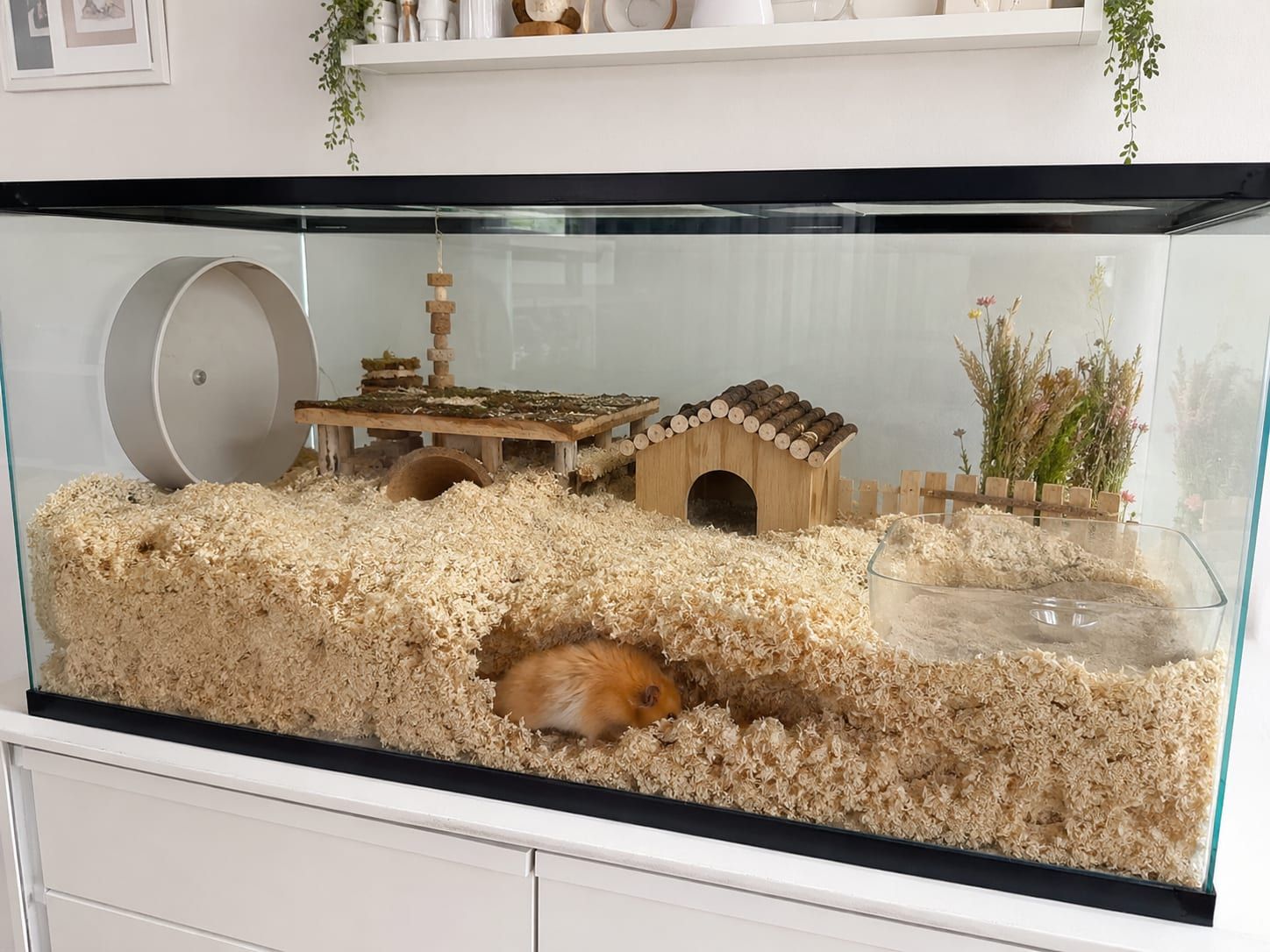
- A detolf-style glass display cabinet laid on its back — a popular choice because it gives well over the minimum in one continuous run
- Purpose-built large enclosures — more expensive, but sold at correct sizes
The cheapest route to a correctly sized enclosure is usually a bin cage, and it will do more for your hamster’s welfare than any wheel, toy or treat you could buy instead.
The rest of the setup follows from size
Once the floor space is right, the other requirements become possible rather than cramped:
- Bedding depth of 25–30cm in at least part of the enclosure, so burrows hold their shape. Paper-based bedding or unscented aspen; never pine or cedar.
- A wheel with a solid running surface — 20cm+ diameter for Syrians, 16cm+ for dwarfs. The hamster’s back should stay flat while running, not curved.
- A sand bath in a heavy dish, using reptile sand rather than dust.
- Multiple hides, so they can choose.
- Chews and forage — scatter part of the food rather than using a bowl.
The hamster care guide covers the daily routine, feeding and handling that sit on top of this.
Common questions about space
Can two hamsters share a big cage? Syrians must live alone — they are solitary and will fight, often fatally, no matter how large the enclosure. Some dwarf species can sometimes be kept in same-sex pairs, but this needs far more space, duplicated resources, and a plan to separate them permanently if it fails. Solo housing is the safe default.
Does a bigger cage mean more cleaning? Less, in practice. A larger enclosure with deep bedding stays fresher for longer because waste is concentrated in one corner. Spot-clean that corner regularly and do a full change far less often — frequent full changes destroy burrows and are stressful.
Is a tall cage as good as a wide one? No. Hamsters are ground-dwelling burrowers, not climbers, and a fall from height is a genuine injury risk. Width and depth beat height every time.
If you are still choosing between small pets, it is worth knowing that hamster housing takes more room than most people expect — the guinea pig care guide and the rabbit care guide set out what those species need, and both need more space again.
The bottom line
100cm x 50cm of unbroken floor space, minimum. Bar spacing of 1/2 inch for Syrians and 1/4 inch for dwarfs. Deep bedding across a wide base, and levels that count as a bonus rather than as floor space.
If the cage on the shelf looks like it would do, measure the base. It probably will not, and a storage tub from a hardware shop will beat it for less money.
Frequently asked questions
What is the minimum cage size for a hamster?+
About 100cm x 50cm of unbroken floor space, which is roughly 775 to 800 square inches, for every species including dwarfs. This figure comes from European welfare guidance and is treated as a minimum rather than a target. Only the base counts — platforms and tubes add climbing but do not add running or burrowing space.
Do dwarf hamsters need a smaller cage than Syrians?+
No. Dwarf hamsters need the same floor space as Syrians. They are smaller but not less active — Roborovskis in particular are among the most active hamsters kept as pets. The one thing that does change with species is bar spacing: dwarfs need 1/4 inch or less, while Syrians can be safe at up to 1/2 inch.
What bar spacing is safe for a hamster cage?+
No wider than 1/2 inch for Syrian hamsters, and 1/4 inch or less for dwarfs, Roborovskis and Chinese hamsters. Roborovskis are the most frequent escapees because they are tiny and fast. If a cage is the right size but the bars are too wide, use a glass tank with a mesh lid, a bin cage, or add fine mesh to the lower bars.
Why does my hamster chew the cage bars?+
Persistent bar chewing is a stress behavior, usually signalling that the enclosure is too small or too bare. It is not a dental requirement — chew toys and normal food keep teeth worn down, and bar chewing can actually damage teeth and the tissue around the mouth. More floor space and deeper bedding fix it far more reliably than adding toys.
Are multi-level hamster cages good?+
The extra levels are a bonus but they do not count toward the minimum. Hamsters are ground-dwelling burrowers rather than climbers, so they need continuous floor area to run and deep bedding to tunnel. Height also introduces a fall risk. Measure only the base of the cage when checking whether it meets the minimum.
How deep should hamster bedding be?+
At least 25 to 30cm in a substantial part of the enclosure, so burrows hold their shape instead of collapsing. Use paper-based bedding or unscented aspen, and never pine or cedar. Deep bedding is not a luxury — burrowing is core hamster behavior, and shallow bedding is one of the most common causes of stress behaviors.
Can I keep two hamsters together in a large cage?+
Syrian hamsters must live alone regardless of cage size — they are solitary and fights are common and often fatal. Some dwarf species can occasionally live in same-sex pairs, but that needs considerably more space, duplicated food, water and hides, and a firm plan to separate them permanently if it goes wrong. Solo housing is the safe default.
Is a bigger cage harder to clean?+
Usually easier. A large enclosure with deep bedding stays fresher longer because hamsters concentrate waste in one corner. Spot-clean that corner regularly and do full bedding changes rarely — frequent full changes destroy the burrow system and are stressful for the hamster.
Sources & further reading
This article draws on guidance from these trusted organizations. Always consult your own veterinarian for advice specific to your pet.
Written by
Raghav DeedwaniyaFounder & Editor
Raghav Deedwaniya is the founder and editor of Petifys, and the author behind its pet care content. I’m a lifelong pet owner, not a veterinarian — I’ve been around dogs since childhood, and that hands-on experience is what got me into writing about responsible pet ownership. At Petifys I create practical, easy-to-understand guides, each one carefully researched using trusted sources such as the AVMA, ASPCA and International Cat Care. My aim is to help you make informed everyday decisions — but for anything involving your pet’s health, always consult a qualified veterinarian who can examine your animal in person.
Disclosure: Some links in this article are affiliate links. If you buy through them we may earn a small commission at no extra cost to you. We only recommend products we believe in. Learn more.